 |
| S.Korea pics |
“…confronted each other hostilely much like southern and northern halves of a partitioned nation”. This could very well have been written about contemporary North and South Korea, but it was actually penned in the early 8th century about the kingdoms of Shilla and Parhae that occupied the Korean peninsula, and were separated by a wall that ran from present-day Pyongyang, the capital of North Korea, in the west to the Sea of Japan in the east. Fast forward to the 21st century, and history repeats itself – the same peninsula cut in half by a Demilitarized Zone or DMZ.
The origins of the DMZ date back to WWII: it was a line drawn at the 38th parallel of Japanese-occupied Korea to mark the areas in which American and Soviet forces would receive Japanese surrender. The US viewed an occupation of Korea as crucial to the postwar stabilization of the Pacific, and set up a three-year military government below the 38th parallel while the Soviets did the same above it. By 1948, two separate republics existed and in mid-1950, the North invaded the South, igniting the Korean War. Three years and two million+ lost lives later, an armistice was reached that restored the old border and created the DMZ, a 2.5-mile wide buffer zone between the two Koreas, nowadays the most heavily militarized border in the world (the irony won’t be lost on anyone) and a major tourist attraction. It should be noted though that a formal peace treaty was never signed.
On the northern side of the DMZ is North Korea, the most isolated country in the world with less than 2,000 Western visitors per year, and where mobile phones and the internet are non-existent. The country is highly militarized, with a minimum 6-year military service for men, and ruled with an iron fist by the Kim dynasty with a vast propaganda machine that promotes a personality cult of the “Supreme Leader”, currently Kim Jong-il, or Lil’ Kim, as I call him. His official biography claims that his birth was foretold by a swallow and marked by the appearance of a double rainbow and a new star in the sky! No wonder Lil’ Kim’s ego is larger than a communist square. And like any other megalomaniac dictator, Lil’ Kim wants perennial power, thus the brinkmanship and nuclearization of the country.
Incidents between the two Koreas are nothing new, but the November 23rd attack on an insignificant South Korean island of some 1,300 inhabitants was one of the most serious recently. And it was not the first this year - in March, North Korea also sank a South Korean naval ship killing 46 soldiers. Many South Koreans think this is enough and support retaliation. The battle of words has started - the new South Korean defense minister said his country will respond with airstrikes if North Korea attacks again and joint US-South Korea military drills took place last week; North Korea warns that these drills could lead to an “all-out war any time”. The stage is set for escalation of hostilities…and one can only hope that Lil’ Kim is not as deranged as he seems to be.
The now divided Korean peninsula was first unified in 668 under the Shilla kingdom with its capital located in Gyeong-ju in the southeastern part of the country. The kingdom had close relations with the Tang dynasty in China and the heavy Chinese influence/alliance lasts to this day and can be seen from religion (Buddhism) to philosophy/ethics (Confucianism) to architecture and trade (China is South Korea’s largest trading partner). Korean historical buildings mirror many that exist in China and tend to follow the same style so unless you’re a history buff, there’s no need to visit lots of them. My favorite was Changdeok Palace in Seoul, not only because it looks recently restored but also because it is one of the largest and doesn’t feel crowded. Morning is the best time to visit as bus tours only hit the palace in the afternoon.
Less palace hopping means that you can do more of what planeloads of Japanese come to Seoul for – shopping. Options abound, including malls that operate from 10:20 am to 5:30 am (!), providing enough hours of retail therapy to cure any emotional malaise. Just don’t forget to bring earplugs lest nonstop insufferable Korean pop music drive you to mass murder. And fear not if you cannot spend hours in a mall – sellers also bring their wares (and voice amplifiers) into subway cars so you can do your shopping while you commute. This is what I call being productive!
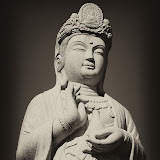
But more bizarre than mobile merchants hawking their merchandise inside subway cars was what happened to me on the last day of the trip. On the spur of the moment I decided to visit Bongeunsa Temple in Seoul and as I was admiring the Buddhas, I suddenly bumped into Jónsi, singer of the Icelandic band Sigur Rós, who has spent most of this year touring with one of the best shows I’ve seen recently. The odds of a NY dweller running into an Icelander musician in an Asian city of 10.4 million people are virtually zero so here’s my question - why can’t I be as lucky with lottery numbers?!

Lucia, você precisa jogar na loteria isso sim!
ReplyDeletedepois de uma viagem como essa!
Com relação aos auto falantes dentro dos meios de locomoção, espera até o pessoal daqui do saara aprender isso. vai ser um inferno hahaha!
beijos!