 |
| Iceland |
Two days before my trip, a volcano that had been dormant since the 1820s erupted in Iceland and all airports were closed. One day before my flight, local air mechanics went on strike and again air travel was disrupted. I started to think that the Viking Gods wanted to foil my trip so when I finally landed in Iceland and headed for my first outing, I felt so happy that I almost jumped out of the hotel lobby like a frolicking gazelle…only to be almost knocked down to the ground, not by a greedy mugger, not by a flock of territorial geese, but by the wind. It makes NYC wintry gusts feel like a gentle fall breeze, and while it kept blowing and forcing me to walk like a drunk, the question crept into my mind – what kind of lunatic would come here outside summer?
The Vikings were certainly tough (or crazy) enough to tackle this environment: they and their Celtic slaves were the first permanent settlers in 874. Isolated for centuries and highly dependent on fishing and agriculture, Iceland was one of the poorest countries in Europe, but experienced substantial growth after its independence in 1944 thanks to Marshall aid and diversification into activities such as services, technology and finance. Nowadays, Iceland is highly developed, ranks 3rd in the latest UN Human Development Index, and boasts one of the highest literacy (99%) and internet penetration (93%) rates in the world. But I bet they wished they had remained isolated when the global crisis hit in late 2008…
Formed by eruptions some 20 million years ago, Iceland has 130 volcanic mountains, of which 15 to 20 active ones continue to shape the landscape. Its volcanoes are so active that an eruption takes place every four to five years, and Iceland has produced 1/3 of the world’s lava output over the past 1,000 years. All this activity is due to Iceland’s unique position: it sits on a hotspot and is cut from southwest to northeast by the Mid-Atlantic Ridge, the boundary between the Eurasian and North American plates that are separating at a rate of 1 in. (2.5 cm) per year.
The most famous volcano in the country is Hekla, known as the “Gateway to Hell” in the Middle Ages. But Hekla is not the most feared; that distinction goes to Katla, which sits underneath a glacier and erupts once or twice every century, the last time in 1918. Its magma chamber is currently full and the recent eruption nearby brought fears that it will trigger Katla. Besides ash clouds that could block solar rays and cause a global cooling, a Katla eruption would melt the glacier and could create a flood discharge larger than the combined flow of the Amazon, Mississippi, Nile and Yangtze rivers.
If on one hand this geological turbulence makes Iceland one of the most unstable places on earth, it gives them cheap geothermal energy: the average electricity/hot water bill is only €35-40 per month. Geothermal waters abound in Iceland, and have become an essential part of the culture: there are close to 200 thermal pools in the country, and the most famous is the Blue Lagoon, a saltwater spa with balmy 104°F (40°C) waters filled with algae, silica and minerals. The first thing I noticed when I got there was the smell of sulphur, and I thought right away that I was in Hekla, the Gateway to Hell. But once I sunk in those incredible clear waters, every muscle in my body loosened up, it felt like heaven, and it was such an experience to be in frigid outdoors wrapped in steaming water that I actually wished it’d snow to make it even more unique. In the end, smelling of sulphur, with algae on my hair and silica mud mask on my face, I probably looked like the deranged child of a Medusa-Joker union…but the Blue Lagoon is an absolute must.
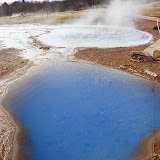
Geysers, hot springs and mud pools are other byproducts of this geothermal power, and in Iceland, you can actually get close to Geysir, the original after which all others were named. Geysir used to blow water 260 ft (80 m) up in the air until some stupid tourists threw rocks and clogged it in the 1950s. It began erupting again after an earthquake in 2000, but not to its former height. It’s hard to see Geysir in action - it only blows 2 or 3 times daily, but Strokkur, its neighbor, bursts every 5 minutes or so.
If fire created Iceland, ice is what made it famous – glaciers cover 11% of the country, and a popular tourist activity is a glacier hike. I picked one that included a bit of ice climbing, and I have to say, the preparations were a pain: you need a harness, a helmet, crampons and an ice axe. It was exhausting putting on all that gear, and when I actually saw the group with those piercing steel crampons and axes, I couldn’t help but think that it would be the perfect beginning for “Saw XIII - Glacial Feast”. Anyway, the crampons were straightforward: we just had to stomp like cavemen. Piece of cake. Ice climbing sounded easy too - stick the axes and the tips of the crampons in, and up you go. But I guess people like me who’ve only seen ice in drinks were not meant to tackle a frozen wall – I only made it to the top after a lot of slipping and ice scraping, and my only consolation is that nobody I know was there to witness my crippled gecko act.
A less strenuous activity is looking for the Northern Lights. Sightings are not guaranteed but our guide assured us from the start – “We’ll find them, don’t worry. I’ll keep my eyes on the sky”. And while I prayed that he didn’t crash while keeping his eyes on the sky, he suddenly stopped the van and yelled “Northern Lights ahead!” We all dashed out, looked up and for a moment I thought he had just had a supersized cup of mushroom tea. The sky looked black! “There they are!”, he said, pointing at what looked like a streak of fading clouds. It was indescribably underwhelming, but I decided to take a picture anyway. And when I saw the photo, I could barely believe my eyes: there it was, a serpent of bright green light (check the woefully blurry picture that looks taken during an earthquake). So when it comes to Northern Lights, your camera, not your eye, is the one that’s going to see it; take an SLR (not a point & shoot), a tripod (very, very, very important), and leave the shutter open at least 15 seconds.
One thing you can only do in Iceland is travel by super jeep, a 4x4 on steroids that can conquer streams, ice, and snow. I joined a tour that took me to Langjökull, the second largest glacier in Iceland at 390 sq. miles (1,000 sq. km), and as my luck would have it, when we got there, the temperature was 16˚F (-10˚C), it was snowing, glacial winds were blowing. As I stood on 16 ft (5 m) of snow in a perfect whiteout, snow whipping my face, no sound other than the wind, that vast glacial desert felt incredibly peaceful, and I was reminded that the most memorable moments in life are not those under perfect conditions, but those with the most spectacular surprises.
In the end, I got the answer to my question: the lunatics that come here are those who want to escape their daily madness and experience one of nature’s masterpieces, a place of dramatic extremes, stark contrasts and endless beauty. A place that awes, captivates and reminds you that there’s a lot more to life than the daily grind.
