Saturday, January 23, 2010

Blood, Baths And Granny's Swimsuits

Hungary

Hungary gets its name from the Huns, nomads who settled briefly in the area under the leadership of the legendary Attila, who eventually headed an empire that stretched from Germany to the Ural River in Russia and from the Danube to the Baltic Sea. Called the Scourge of God by the Romans, he was one of their most feared enemies, and is to this day remembered in Western Europe as a cruel warrior who devastated and plundered anything in his path. For Hungarians and Turks, though, Attila is revered as a hero and described as a great and noble king. Mighty though as he was, his death was quite embarrassing: he drunk heavily on the night of his wedding, suffered a massive nosebleed and choked on his own blood (!) This “nosebleed” was likely due to rupture of the esophageal varices, a major cause of death for chronic drinkers where victims drown in their own blood. I know this sounds like I swallowed a medical encyclopedia, so for laypeople, let’s just call it gross.

The Hun empire crumbled after Attila’s death in the 5th century, and several tribes tried unsuccessfully to secure a foothold in the region. Finally towards the end of the 9th century, Magyar tribes settled in the area and after converting to Christianity, founded the Hungarian state in 1000. It became a powerful kingdom that included present-day Hungary, Slovakia, Croatia, Transylvania (now in Romania) and Transcarpathia (now in Ukraine). Defeat to the Ottomans in the 16th century led to the breakup of the empire between the ever-present Habsburgs and the Ottomans. The former expelled the latter in the 17th century, but the Austro-Hungarian defeat in WWI saw Hungary losing more than 2/3 of its former territory. The country sided with Nazi Germany in hopes of recovering lost lands only to fall into communist hands post-WWII.

For a good part of the nation’s history, Buda was its capital and Budapest today is the result of the union of three cities that grew together: Buda, west of the Danube, Óbuda to the north and Pest to the east of the Danube. Buda and Pest have very different characters: Buda covers about 1/3 of the capital, and is mostly wooded, hilly and residential; Pest comprises 2/3 of Budapest’s territory, and is flat and commercial. In Pest you’ll find the Parliament, perhaps the most well known building in the city, most hotels, bars, restaurants, and pedestrian streets lined with stores. In Buda, as you’d expect in any ancient city with a hill, you’ll find Buda Castle and right by its side, Fishermen’s Bastion, both a must on any visit to Budapest.

Buda Castle may appear bland at first when you see it from Pest, but just walk into its main courtyard and your jaw will drop. There are amazing sculptures and if you wait until dark, you’ll get a chance to see the castle in one of the best lighting jobs I’ve ever seen: a mix of yellow and white lights that give it depth, enhance contrast and seem to make it larger. Fishermen’s Bastion is a terrace with seven towers, each representing the seven Magyar tribes that settled in the Carpathian Basin. The terrace will surprise you with its many nooks and cranes, and one detail that can easily go unnoticed – look closely at the columns and you’ll see that each pair has a unique design.

If pigging out is your thing, Hungary is the place to be. At a traditional Hungarian restaurant, you’ll be amazed not only by how exotic but also by how large the dishes are. Fried pork liver, baked goose, beef steaks the size of pizzas, crispy leg of pork, lung in sour sauce, pasta dishes that look like erupting volcanoes. And as I looked at all that, my only thought was “God, I’m gonna starve!” There weren’t many vegetarian options, and the few I could find almost always involved oil, loads of it. Fried aubergine, fried zucchini, deep fried mushrooms, deep fried cheese. I didn’t go hungry, but by the time I left Hungary, I had so many zits that my face looked like the Himalayan chain.

But if it had occurred to me to bring a bikini to my winter vacation, I might have taken care of my zits right there at an authentic Hungarian thermal spa. Thermal baths are part of Hungarian culture, have existed since Roman times, and are said to treat a variety of ailments such as aches, skin diseases, diabetes, rheumatism, circulatory problems and the list goes on. We came across Széchenyi Baths in City Park, which happens to be the largest spa complex in Europe, and offers a variety of services that include aqua aerobics, body toning, massage, manicure, pedicure, infra sauna and even consultation with a bath physician. I was very tempted to take a dip when I saw those blue steaming pools, and the truth is that I could have - there were actually bathing suits for rent. But even if the idea of renting a bathing suit didn’t freak me out, I would never be caught dead in one of those vintage models that would only look hip on my great-great-great-grandmother.

Sunday, January 17, 2010

Gothic Ghosts

Czech Republic and Slovakia
November 2009 marked the 20th anniversary of the fall of communism, and since then, the Czech Republic has become one of the most stable and prosperous countries of the former communist bloc. The origins of the Czech state can be traced back to the 9th century when it emerged as the kingdom of Bohemia but for most of their history, Czechs were under foreign dominion: from 1526, Bohemia was under Habsburg control until the collapse of the Austro-Hungarian empire after WWI led to the creation of the Republic of Czechoslovakia. Independence was short-lived though as the country was occupied by Nazis in 1939. German occupation ended in 1945, but in 1948, the Soviets backed a coup d’état that established an all-communist government that would lead the country for the next 41 years. With the fall of communism in 1989, Czechoslovakia embraced democracy, but Slovak national aspirations grew until the country peacefully split into the Czech Republic and Slovakia.

Prague, the Czech Republic’s capital, is deservedly one of the world’s most popular tourist destinations. You can’t help but become enchanted by the city – its cobbled streets lined with pastel buildings, its churches and bridges in varying styles, its horse-drawn carriages make Prague a quintessential fairy-tale city with hardly a rival in the world. Prague has been called “The Mother of Cities”, “The Golden City” and “City of A Hundred Spires”, but I’m surprised it’s never been called “City of A Hundred Bridges” since it reputedly has more than 300 of them. Undoubtedly, the Charles Bridge is the most famous, built in the 14th century and at the time the only crossing between the Old Town and Prague Castle. The bridge is flanked by three towers in gothic style and dotted with 30 baroque statues representing saints, all of them looking duly pious and martyred, though somewhat soot-black.

Throughout its 650+ year history, the bridge has withstood floods, wars, cannonades, and some say that the bridge’s longevity has to do with the laying of its foundation stone. Legend has it that King Charles IV had royal astrologers and numerologists determine the most auspicious moment, which turned out to be in 1357 on the 9th day of the 7th month at 5:31 am. This moment is written as 135797531, a sequence of ascending and descending odd digits, believed to be a magical combination that protects the bridge (cue Harry Potter theme song).

That’s not the only myth associated with the bridge. The most famous statue there is that of John of Nepomuk, a vicar and the confessor of the queen of Bohemia. The king, suspecting that his queen had a lover, ordered John to reveal her confessions. When the vicar refused, the king had him tortured and thrown into the river. There is now a small cross on that spot, and supposedly if you touch it and make a wish, it will come true within a year and one day, by which time, of course, you’ll have completely forgotten that you ever did this.

One of Prague’s most iconic symbols soars over the city – Prague Castle, the biggest ancient castle in the world, with an area of ~750,000 sq. ft. (~70,000 sq. meters). Founded in the 9th century, the castle includes palaces and ecclesiastical buildings that span every architectural style of the past millennium. The most prominent structure is the gothic St Vitus Cathedral, the tallest in the complex. Now, I did mention in the Milan post that God, the Overachiever, must have pulled His hair out watching the 579-year construction of the Duomo. Amazingly, St. Vitus took even longer: construction began in 1344 and did not end until 1929, merely 585 years later. I have two hypotheses: either all these gothic architects and engineers were a bunch of feet draggers or their bosses didn’t know what they wanted and kept changing their minds. Which one do you think it was?

There’s a legend surrounding Prague Castle too: it is said that any usurper who places the Crown of Saint Wenceslas on his head will die within a year. During the Nazi occupation, Reinhard Heydrich was named the Reich Protector of Bohemia and Moravia and made Prague Castle his headquarters. Rumor has it that he placed the Bohemian crown on his head, and, lo and behold, he was assassinated less than a year later (cue horror theme).

On the other side of the river, the Old Town (Staré Mĕsto) is a tourist hub. It is Prague’s historic core dating from the 9th century, centered on the Old Town Square. Its most popular feature is the Astronomical Clock, which attracts crowds with the parade of characters that glide by as the clock strikes the hour: the Twelve Apostles and the “evils” of life per 15th century –Vanity, Greed, Death and Lust. To be honest, I find the “parade” very underwhelming but throngs gather to watch it every hour so feel free to join. Just don’t forget to check the most interesting piece, which is the clock itself, showing not only the time, but also the month, the zodiac, and the positions of sun and moon. I found it way more appealing than the “parade”.

As you’d expect, there’s a legend associated with the clock: rumor has it that the nice people of the Municipal Council gouged clock artist Hanus’s eyes to prevent him from making a similar one elsewhere. Hanus then threw himself into the clock mechanism and died, after which the clock stopped working and remained out of order for almost a century (cue ghastly ghost sounds). With stories like that, it’s no wonder that Prague is known as the most haunted city in the world!

Saturday, January 16, 2010

The Bronx Rises Again

Out of sheer chance, I ended up visiting Slovenia and Slovakia in the same year, probably the two countries that people confuse the most. To recap, Slovenia was part of Yugoslavia and its independence came after a 10-day standoff that could have ended up in war; Slovakia was part of Czechoslovakia and its independence came when the federation split peacefully at the beginning of 1993. Like the Czech Republic, Slovakia was under foreign rule for most of its existence: first, the Hungarians from the 10th century, then the omnipresent Habsburgs before joining Czechoslovakia after WWI, and falling into communist hands after WWII.

Slovakia promotes itself as “Little Big Country” and little it is: the country’s maximum length is 265 miles (~428 km) and its maximum width is 121 miles (~195 km). The Western Carpathian Mountains cover most of the country’s territory and forests account for almost 40% of its land, making Slovakia a good destination for hiking, skiing or rock climbing. I’d have checked some of Slovakia’s nine national parks but freezing my butt outdoors in winter is not my idea of a fun vacation so I stuck to the capital Bratislava, a compact city whose main sights can be seen on a single day. We ended up staying 3 days, however, thanks to the hospitality of our friends Barbara and Joachim, who welcomed us like family and made it hard for us to leave.

Bratislava is the only capital in the world to border two countries: Austria to the west and Hungary to the south. It is less than 37 miles (60 km) from Vienna, making them the two closest capitals in Europe. They are sometimes erroneously named the two closest capitals in the world, but that title actually goes to Kinshasa in the Democratic Republic of the Congo and Brazzaville in the Republic of the Congo, only 1 mile (1.6 km) apart.

Bratislava straddles the Danube, with one bank nestling the medieval inner city and the other reflecting the communist years. The historic Old Town contains the typical winding streets and ancient buildings, and its main attraction is Bratislava Castle on a hill above the Danube, from where there are great views of the city, both old and new.

The castle is not the most photographed attraction in Bratislava, however; reputedly, it is a bronze statue of a man peeping out of a manhole, known as Cumil (The Watcher), one of a few quirky statues put in place to enliven the city. He has his own “Man At Work” sign, and you can only imagine it’s some kind of joke about the way things used to work under communism…except that he wouldn’t be smiling.

Speaking of which, communism left a heavy imprint on Bratislava: almost 25% of the Old Town was razed to make way for a bridge connecting the old to the new part of town. The bridge opened in 1972, and became known as the UFO Bridge because it looks like a flying saucer parked there. The spaceship is actually an observation deck cum bar/restaurant and according to its website “In 45 seconds lift will take you from ground level to the point “wow”. In hight of 95 metres and with visibility upto 100 km unique experience can start.” Desperately needed: a good marketeer and someone who can spell English.

The communist and English-challenged bridge leads to another communist legacy: Petržalka, a concrete gray housing monstrosity that seemed to be all the rage among tasteless communist planners. 115,000 people (~25% of Bratislava’s population) live there, and the complex used to be called the Bronx of Bratislava due to the high crime rate and drug dealing. Statistics indicate that the crime rate now is at the same levels as other boroughs’, and some of the buildings got a colorful paint job to make them less gloomy. So will the Bronx of Bratislava shed its shady past? Time will tell. All I can say is that I avoided Petržalka like the plague.

Sunday, January 10, 2010

Bluer Than...Green

Austria
Vienna gave us a most polar welcome. At 16˚F (-9˚C), as icicles formed on my eyelashes, as my fingers, toes and face went numb, as my teeth chattered, there was only one thing I could think of: where is global warming when you need it?!

Despite this polar ordeal, “There is only one imperial city – there is only one Vienna”, as Johann Strauss said. Inevitably when you set foot there, you will think of his The Blue Danube. As you go through the city streets, eagerly anticipating your first glimpse of the river that inspired such a celebrated piece, you almost wish you could waltz your way down, twirling without a care in the world. And as you continue on your imaginary waltz, before you know it you arrive almost breathless at the river with its waters of a remarkable murky green. Murky green?! Did Strauss smoke something? Was he into deceptive advertising? Or was the Danube really blue in 1866, and in the years since pollution, acid rain, urban runoff, global warming, you name it, have unblued the Danube? I may never know, but I’m not the only one obsessed with its color: someone in Vienna spent one year watching the Danube, and concluded that it was green 255 days, gray 60 days, yellow 40 days, brown 10 days and not once blue. But whatever its color, the Danube has historically been one of the most important rivers in Europe: it was the northern boundary of the Roman Empire and a key trade route in medieval times, giving rise to several trade and transportation centers along its shores, including Vienna.

Vienna was at the heart of the Habsburg Empire, one of the most powerful European dynasties that ruled for over 600 years and that, at one time or another, included Austria, Hungary, the Czech Republic, Slovakia, Slovenia, Croatia, Bosnia-Herzegovina, and parts of Italy, Poland and Romania. Perhaps the most well known member of the Habsburg House was Franz Ferdinand, not the Scottish rock band, but the heir to the Austro-Hungarian throne whose assassination in Serbia in 1914 precipitated World War I and the fall of the Habsburgs. Franz Ferdinand was an avid hunter and is said to have made some 300,000 kills, 100,000 of which are on display at his former castle one hour outside Prague. How tasteful! Ironically, he was killed by a bullet that pierced his jugular. Coincidence or karma?

The empire may be gone, but Vienna retains the imperial aura in its splendid and varied architecture, its palaces, its museums filled with treasures. The main area of interest is the old town, called Innere Stadt and encircled by Ringstraβe, a series of boulevards built where the old city walls stood. It is not only the historic heart of the city, but also its administrative, political and cultural center, housing the parliament, the city hall, the Vienna State Opera, the Imperial Court Theatre, a number of museums, the Hofburg Imperial Palace (the Habsburgs’ winter quarters and now the official residence of the President) and Stephansdom, or St. Stephen’s Cathedral, a Gothic structure that is one of the city’s main landmarks. If you’re into the creepy, you can visit the cathedral’s catacombs where you’ll find internal organs of former Habsburg rulers. How tasteful!

But rich in attractions as Innere Stadt is, the most visited place in Austria is Schönbrunn Palace, the former summer residence of the Habsburgs, less than 5 miles (~7.5 km) from St Stephen’s. The palace contains 1,441 rooms, and not only do I get exhausted thinking of the size of the whole thing, but I also picture myself getting lost inside, perishing and having my carcass found decades later. Maybe they’d even hang my skeleton under a “Dead Lost” exhibit (Austrians are reputedly fascinated with death…) but that’s not how I want my 15 minutes of fame. So fortunately for the survival of tourists, you can only visit 22 rooms if you take the Imperial Tour or 40 with the Grand Tour. Get there early and try to avoid weekends because the place gets packed to the gills. I myself prefer the gardens, free and much less crowded.

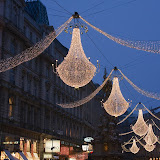
Vienna remains imperial even for mundane things such as Christmas celebrations. Graben, the main pedestrian street in Innere Stadt, was decorated with huge chandeliers that made me think I was in a palatial ballroom, and I’m sure I’d have felt like royalty if I weren’t shivering so much. There’s street caroling worthy of regal ears, and, throughout town, Christmas markets, not imperial in the least, but very crowd-pleasing. These street markets originated in the Middle Ages, and the ones in Vienna date back to 1294. Nowadays there are almost a dozen of them around town, the largest (and most commercial) in front of City Hall, where kids can meet Santa Claus, courtesy of Coca-Cola (right, catch them when they’re young…). They all sell seasonal items, food and drinks, particularly Glühwein (mulled wine served steaming hot). If you know me, you know I don’t drink, but I was so desperately cold that I started to down Glühwein like water to keep myself warm. So the world started to spin a little, and not from any waltzing I was doing…I hope.

The Hills Are Alive...With The Sight Of Pigs

The mountains, the baroque buildings, the countless steeples. But there was one thing that was ubiquitous in Salzburg - pigs. Sausages on every food stall, ham virtually on every dish, plush toy pigs, pig keychains, hats shaped like pigs, pig T-shirts, bread and sweets in the shape of pigs. Had I accidentally fallen into a pigsty? What was that about? In times of war, people didn’t have much to eat, and families with pigs were considered fortunate because they wouldn’t starve. Therefore pigs in Austria became a symbol of good luck, and are seen everywhere around New Year. I’m not sure pigs themselves would agree: besides having their image exploited royalty-free, they get slaughtered. If I were a pig, I’d stage a revolt à la “Animal Farm” and really take over Salzburg. Power to the piggies!

With so many pig symbols, you’d think Salzburg owes its existence to pig farming, but it was actually the mining of salt, a valuable commodity and at one point called “white gold”, that put Salzburg on the map. Salt was so important to Salzburg that it even gave the town its name, which translates as Salt Castle. But Salzburg is more often associated with music and its most famous son is Mozart.

Mozart needs no introduction. The man was a musical genius – he started composing at 5, wrote over 600 pieces during his short 34-year life and was able to write down entire scores from memory after hearing them only once. He was born and lived in Salzburg until 24, but left as soon as he could because he earned little as a court musician and didn’t have many opportunities to compose what he wanted. Salzburg may have been a bad fit for him, but the town idolizes him in every possible way. There’s the Mozart birthplace, the house where Mozart grew up, and, more than anything else, the Mozart chocolate. On every supermarket, grocery store, souvenir shop, food stall there it is - his face on countless chocolate boxes. I’m sure Mozart wanted to be remembered; I’m not sure though that he’d have wanted to become a chocolate poster boy.

Music also put Salzburg in the spotlight in the 20th century – namely the movie The Sound of Music, which tells the story of the Trapp singing family who fled the Nazis and went to the U.S. in the late 1930s. The real Maria von Trapp sold the story rights to Hollywood for a mere US$9,000 but when she actually saw the movie, she got really upset with all the inaccuracies and was going to denounce it. 20th Century Fox then offered her US$900,000 and she was upset no more.

Austrians don’t seem too fond of the movie either, but the truth is that the most popular tours in Salzburg are those that take you to some of the movie’s locations. They sounded cheesy to me, but I joined one with Panorama Tours anyway and was glad I did because Peter, our guide, was excellent and made me laugh almost all the way through by making fun of all the absurdities in the movie. Plus, we got lucky with the weather and were able to see some beautiful scenery along the way.

And to prove that Salzburg is not only about music of ages past, one of the holiday events was a free rock concert at one of the town’s squares. The band played covers for 2.5 hours and closed the show with a song by…Abba! And after watching them, it became blatantly clear why there is no famous Austrian rock band.