 |
| Austria |
Despite this polar ordeal, “There is only one imperial city – there is only one Vienna”, as Johann Strauss said. Inevitably when you set foot there, you will think of his The Blue Danube. As you go through the city streets, eagerly anticipating your first glimpse of the river that inspired such a celebrated piece, you almost wish you could waltz your way down, twirling without a care in the world. And as you continue on your imaginary waltz, before you know it you arrive almost breathless at the river with its waters of a remarkable murky green. Murky green?! Did Strauss smoke something? Was he into deceptive advertising? Or was the Danube really blue in 1866, and in the years since pollution, acid rain, urban runoff, global warming, you name it, have unblued the Danube? I may never know, but I’m not the only one obsessed with its color: someone in Vienna spent one year watching the Danube, and concluded that it was green 255 days, gray 60 days, yellow 40 days, brown 10 days and not once blue. But whatever its color, the Danube has historically been one of the most important rivers in Europe: it was the northern boundary of the Roman Empire and a key trade route in medieval times, giving rise to several trade and transportation centers along its shores, including Vienna.
Vienna was at the heart of the Habsburg Empire, one of the most powerful European dynasties that ruled for over 600 years and that, at one time or another, included Austria, Hungary, the Czech Republic, Slovakia, Slovenia, Croatia, Bosnia-Herzegovina, and parts of Italy, Poland and Romania. Perhaps the most well known member of the Habsburg House was Franz Ferdinand, not the Scottish rock band, but the heir to the Austro-Hungarian throne whose assassination in Serbia in 1914 precipitated World War I and the fall of the Habsburgs. Franz Ferdinand was an avid hunter and is said to have made some 300,000 kills, 100,000 of which are on display at his former castle one hour outside Prague. How tasteful! Ironically, he was killed by a bullet that pierced his jugular. Coincidence or karma?
The empire may be gone, but Vienna retains the imperial aura in its splendid and varied architecture, its palaces, its museums filled with treasures. The main area of interest is the old town, called Innere Stadt and encircled by Ringstraβe, a series of boulevards built where the old city walls stood. It is not only the historic heart of the city, but also its administrative, political and cultural center, housing the parliament, the city hall, the Vienna State Opera, the Imperial Court Theatre, a number of museums, the Hofburg Imperial Palace (the Habsburgs’ winter quarters and now the official residence of the President) and Stephansdom, or St. Stephen’s Cathedral, a Gothic structure that is one of the city’s main landmarks. If you’re into the creepy, you can visit the cathedral’s catacombs where you’ll find internal organs of former Habsburg rulers. How tasteful!
But rich in attractions as Innere Stadt is, the most visited place in Austria is Schönbrunn Palace, the former summer residence of the Habsburgs, less than 5 miles (~7.5 km) from St Stephen’s. The palace contains 1,441 rooms, and not only do I get exhausted thinking of the size of the whole thing, but I also picture myself getting lost inside, perishing and having my carcass found decades later. Maybe they’d even hang my skeleton under a “Dead Lost” exhibit (Austrians are reputedly fascinated with death…) but that’s not how I want my 15 minutes of fame. So fortunately for the survival of tourists, you can only visit 22 rooms if you take the Imperial Tour or 40 with the Grand Tour. Get there early and try to avoid weekends because the place gets packed to the gills. I myself prefer the gardens, free and much less crowded.
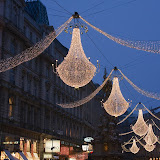
Vienna remains imperial even for mundane things such as Christmas celebrations. Graben, the main pedestrian street in Innere Stadt, was decorated with huge chandeliers that made me think I was in a palatial ballroom, and I’m sure I’d have felt like royalty if I weren’t shivering so much. There’s street caroling worthy of regal ears, and, throughout town, Christmas markets, not imperial in the least, but very crowd-pleasing. These street markets originated in the Middle Ages, and the ones in Vienna date back to 1294. Nowadays there are almost a dozen of them around town, the largest (and most commercial) in front of City Hall, where kids can meet Santa Claus, courtesy of Coca-Cola (right, catch them when they’re young…). They all sell seasonal items, food and drinks, particularly Glühwein (mulled wine served steaming hot). If you know me, you know I don’t drink, but I was so desperately cold that I started to down Glühwein like water to keep myself warm. So the world started to spin a little, and not from any waltzing I was doing…I hope.

No comments:
Post a Comment