 |
| Galapagos & Guayaquil |
I’ve lost count of how many islands are called a paradise, a dream, happy, pure, etc, etc. But the Galápagos live up to its moniker of Enchanted Isles with its combination of varied landscapes, clear waters, tropical climate and, last but not least, unique fauna/flora. The latter has made Galápagos one of the most protected areas in the world and for good reason: half of its terrestrial and 1/5 of its marine species are found nowhere else on earth. The archipelago’s rise to fame came after Charles Darwin toured the islands for five weeks in 1835, and noted significant differences between plants and animals on the mainland and the various islands. His observations led him to wonder if species could adapt to a new environment over time, and for the following 25 years, Darwin developed his theory of evolution, driven by a process called natural selection. His book The Origin of the Species, published in 1859, was a sensation, and made Galápagos famous worldwide as a natural laboratory of evolution.
The Galápagos are a series of islands (13 major ones, 6 minor and over 40 islets) located 600 miles (965 km) west of mainland Ecuador that were formed four to five million years ago by eruptions of underwater volcanoes. The word volcano came like music to my ears, and since I missed the grand eruption of the now (in)famous Eyjafjallajökull, I actually did a volcano dance when I got to Isabela, one of the newest islands with 5 volcanoes, hoping that one of them would spit a little lava for my delight. But I’m a wanderer, not a dancer, and my clumsy dance screwed things up: a volcano did erupt, but near Quito, not in the Galápagos, causing the closure of a major airport and almost leaving me stranded.
The archipelago is home to 30,000 people over four inhabited islands and receives 180,000 tourists annually. Most visitors tour the islands on cruises that range from four days to three weeks, with the most popular lasting from four to eight days. To minimize human impact on the islands, all boats must include a certified naturalist guide trained by the National Park Service to help you better appreciate what you’re seeing and ensure rules are followed. Furthermore, tourists can only access official visitor sites, and the number of visitors on each site is capped at any point in time. While these rules may seem restrictive at first, they do contribute to conservation efforts and I ended up liking them because it meant that there wouldn’t be throngs everywhere I went, making the visits much more enjoyable.
And there’s much to enjoy. The biggest attraction in the Galápagos is wildlife, of course, and animals in general have lost all fear of humans, letting us get really close. I could barely contain my excitement, and seeing them just a few feet away made me do totally counterintuitive things, like chase a shark (cue “Jaws” theme and horrified shrieks). For my life’s sake, it wasn’t a great white, but rather a white tipped reef shark, usually no bigger than 6 feet, and friendly like all Galápagos wildlife – they normally don’t go after people.
If you read my Barbados snorkeling (mis)adventure last year, you know that I swallowed more water than saw marine life, and I was a bit worried because this trip included daily snorkeling activities. But aside from not putting enough sunscream (as some local stores describe it) and getting my back looking like burned toast, everything went smooth this time, and I was even let in on the high-tech secret to keeping your mask fog-free: spit in it. Very charming. I must be saliva-deficient and just couldn’t do it so my mask was always foggy, but even then, I saw a lot: schools of fish all around, stingrays gliding underneath, turtles swimming so close that many times I almost crashed into them, wondering in terror if they’d bite me if I did.
And sea lions, the so-called golden retrievers of the Galápagos. They’re usually found on beaches or rocky shores, and if I have a choice, in my next life I want to be a sea lion on Gardner Bay in the island of Española: no predators, a white sand beach to laze the day away, and turquoise waters to take a dip in when I get tired of basking in the sun. They sleep so much that I wished I had an alarm clock to get them to at least open their eyes.
Sea lions in the Galápagos don’t mind people at all, and it’s always love at first sight because you can’t help but be captivated by such a trusting animal. And if on land they look like a barking yucca root that grew flippers, in the water they are graceful, agile and playful. When I snorkeled among them, at times they’d come out of nowhere, and head straight towards me as though they were going to crash into my face, only to swerve just inches away from me, then swim around right side up, upside down, round and round, and spinning down. Their antics made me laugh, and, of course, almost drown with all the seawater I swallowed while laughing.
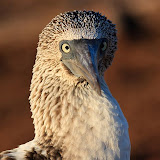
The Galápagos are also a bird watcher’s paradise, especially in Punta Suárez in Española, and the island of North Seymour. Blue-footed boobies are arguably the most famous bird species in the archipelago, not only due to their bright blue feet, but also their strange mating dance, in which the male moves like he’s stepping on eggs to show off his blue feet, stopping every now and then to whistle and boast his wing span to the female. Watch it in this video by National Geographic.
But the Mating Dance Oddity Award goes to the magnificent frigatebird: to attract females, males inflate a bright red pouch on their chest, and when a female flies by, they trill and shake their body all over like a drag queen in a Rio carnaval party. Watch it in this video by Nihoa
But while all this may sound fun and heavenly, reality is not so rosy – native species are threatened by habitat loss, overfishing, non-native species (such as domestic animals), and climate changes. 50% of the Galápagos flora and fauna species are currently threatened or endangered mostly as a result of human actions. The Galápagos National Park has several programs to prevent further habitat deterioration, but they can’t tackle all the issues. It is up to each of us to minimize our impact on other species, not only in Galápagos but everywhere we go, and make sure they continue to play a role in our planet.

No comments:
Post a Comment