 |
| Slovenia |
Yugoslavia (literally “Land of the South Slavs”) was the idea for a single state for all South Slavic peoples and came into being after WWI. During WWII, Yugoslavia was occupied by Nazi and Fascist armies, and the communist Yugoslav Partisans, led by Marshal Tito, became a major resistance force. After the end of the war, Tito, regarded as a hero, was elected to lead the new independent communist state of Yugoslavia, which comprised six socialist republics (Bosnia and Herzegovina, Croatia, Macedonia, Montenegro, Serbia and Slovenia) and two autonomous provinces (Kosovo and Vojvodina), where all nations and nationalities were supposed to have equal rights. However, resentment over Serb hegemony within the federation led to ethnic tensions and after Tito’s death in 1980 and the fall of communism, nationalism grew, particularly in Slovenia and Croatia. On December 23, 1990, Slovenes overwhelmingly voted for independence, and on June 25, 1991, Slovenia pulled out of the Yugoslav Federation. Two days later, the Yugoslav army marched into Slovenia, but met strong resistance and threatened war. But unlike other republics, there were no minority issues (ie, there was no Serb minority in Slovenia), and on July 7, ten days after the beginning of the conflict, the Yugoslav government agreed to withdraw its troops from Slovenia within three months. Since its independence, Slovenia has been the most stable country of the former Yugoslav republics.
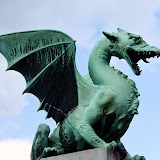
Slovenia is small, covering only 7.8 sq. mi (20 thousand sq. km). Its population is 2 million, and only 276,000 call the capital Ljubljana home. According to legend, the Greek prince Jason and the Argonauts (perfect name for a pop band) stole the golden fleece from King Aites and fled through seas and rivers until they reached the Ljubljanica River. Upon arriving, they were attacked by a dragon, but managed to slay it and founded Ljubljana. Nowhere in the city can you find any mention of or homage to Jason and the Argonauts, his bandmates…I mean, his companions, but the dragon, on the other hand, is immortalized on the city’s coat of arms and flag, on the Dragon Bridge and in numerous souvenir shops as a plush toy.
The city feels like a small town, and was the perfect place to kick back and relax after the overwhelming crowds in Venice. Ljubljana lacks major landmarks, but makes up for it with a rich cultural calendar during summer. When we arrived the Jazz Festival was on, as was the Ana Desetnica street theatre festival, in which artists from several countries (from Argentina to Australia) fill streets and squares with music, dance, mime, and circus acts. Some performances were basic, like juggling and fire eating, but others were more elaborate. My favorite was one in which a troupe (several of them on stilts) arrived on a white “ship” at Prešernov Trg, the main square, and at some point unrolled this gigantic tube; everyone was wondering what that was for and soon the answer came – it was for blowing out foam, which soon covered the audience, and turned the square into a sea of foam in which everyone was dancing and frolicking! That was a blast!
With only 28 miles (45 km), the Slovenian coast is very small, but there is an alternative: the subalpine Lake Bled, located about one hour from the capital. The lake sits among mountains and is one of the most popular destinations for Slovenes, where they ski in winter and sunbathe, swim or canoe in summer. It’s also very popular for weddings: besides the picture-perfect scenery, there’s a church on a small island in the middle of the lake. Wedding parties board a local boat called pletna and glide through the waters to the bottom of the church stairs. That surely beats arriving in a limo.
Beautiful though as Bled is, it’s not the #1 attraction in the country. That distinction goes to the Postojna Cave, the longest cave system in the country where so far 12 miles (20 km) of subterranean paths have been discovered. The caves are pretty impressive, with soaring chambers, massive stalagmites and stalactites, but I didn’t like much how the visit is organized: you board an open train that meanders through 2.5 miles (4 km) to the bowels of the cave (tall people have to watch out because some of the galleries are so low they could give you a few stitches on the head), then you are assigned to a group based on language, and herded through a 1-mile path (1.7 km). More fun should be one of the underground adventures for small groups (3-day advance booking required), which takes you to areas not open to the general public.
A visit to the cave can be combined with a stop at Predjama Castle, 5.5 miles (9 km) away. While the interior is bland, the setting is extraordinarily unique – the castle is perched on a cliff under a natural arch and seems to grow right out of the mountain. The castle was featured in Ghost Hunters International last year and the conclusion was that the castle is indeed haunted. I bet it’s the ghosts of Jason and the Argonauts, totally ticked off because, after all, it’s the Dragon that rocks.

No comments:
Post a Comment